Particle Counter Data and the Cleanroom Compliance Gap Nobody Talks About
Environmental monitoring generates some of the most compliance-sensitive data in GMP manufacturing. In most facilities, it still moves by hand.
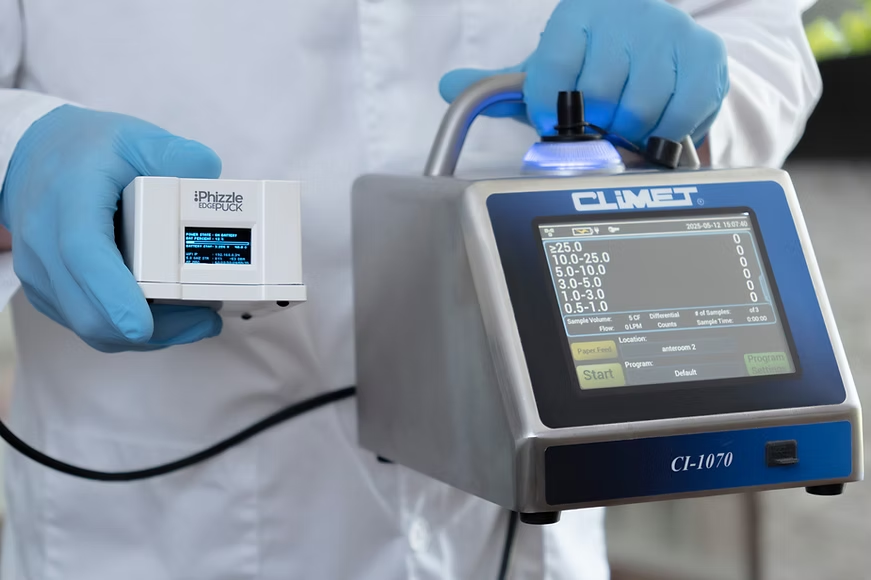
Environmental monitoring is not peripheral to pharmaceutical manufacturing quality. It is foundational. The data generated by particle counters and environmental sensors in GMP cleanrooms is the documented basis for demonstrating that the production environment meets the classification requirements necessary for the product being manufactured.
That data also, in most facilities, still moves by hand.
The Manual Environmental Monitoring Workflow
A typical GMP environmental monitoring workflow involves multiple sampling points across a cleanroom or controlled area, measured at defined frequencies across multiple shifts. For each measurement, an operator gowns, enters the cleanroom, and positions the particle counter at the specified sampling location. The counter runs for the defined sample period. The operator reads the result from the instrument display, records it on a paper form or portable log, exits the cleanroom, removes gowning, and transcribes the result into the facility's environmental monitoring system.
That sequence is executed dozens or hundreds of times per day across a typical GMP manufacturing environment. Each execution is an opportunity for the documentation to diverge from the measurement.
The Compliance Risk in Manual Particle Counter Data Handling
The compliance implications of manual particle counter data handling are specific and predictable.
Transcription error is the most straightforward risk. A particle count read from a display and recorded by hand is subject to misreading, digit transposition, and decimal placement errors. In a cleanroom environment where limit specifications may be tight and where a single out-of-limit result triggers a deviation, a transcription error can create a false negative — a result that appears to be in range when the actual measurement was not.
The inverse risk is equally problematic: a correctly measured out-of-limit result that does not reach the documentation system because the paper form was lost, the entry was delayed, or the operator made an error in transcription. An unreported out-of-limit result in a GMP cleanroom is both a documentation failure and a potential product quality event.
Delayed documentation is a regulatory concern independent of accuracy. 21 CFR Part 11 and the ALCOA standard both require that records be contemporaneous — created at the time of the activity being recorded. A result that is transcribed into a system thirty minutes after measurement is not contemporaneous in the strictest sense. In an inspection context, that distinction can become a data integrity finding.
Operator entry frequency compounds all of these risks. Every manual data collection event requires a cleanroom entry. Each entry carries a contamination risk. Programs that require high-frequency monitoring at multiple locations generate a significant number of entries per shift — each one a compliance touchpoint and a contamination exposure.
What Automated Particle Counter Data Capture Changes
Automated data capture for particle counters eliminates the transcription step by connecting the instrument directly to the documentation and data management system.
In a connected environmental monitoring workflow, the operator configures the sample at a remote interface — outside the cleanroom — specifying the location, sample duration, and operator identification. The counter runs the sample. The result is captured directly from the instrument output, formatted per the specifications of the receiving system (LIMS, QMS, or environmental monitoring platform), and written to the record at the moment of measurement.
The operator enters the cleanroom to position the instrument and initiate the sample — or, in facilities using automated counter positioning, does not need to enter at all. The documentation is complete when the sample is complete.
What changes in the compliance picture:
- The record is contemporaneous by design. The timestamp is attached to the instrument measurement, not to the moment an operator had time to enter a value into a system.
- Out-of-range results are flagged immediately and routed to the appropriate reviewer — before the production area continues operating on the assumption that results were in range.
- The audit trail captures the full chain: instrument identification, operator identification, sample location, sample time, and result. No reconstruction required.
- Entry events are reduced. In facilities where monitoring can be configured remotely and results are captured automatically, cleanroom entry for data collection purposes decreases significantly.
The Edge Puck™ in Cleanroom Environments
Cleanrooms present a specific implementation challenge for instrument connectivity hardware. The gateway device that sits between the instrument and the enterprise network must be compatible with cleanroom facility standards — including cleanability, form factor, and the inability to introduce contamination risk through the device itself.
Connected Plant addresses this through the Edge Puck™, a purpose-built, self-contained, cleanable gateway designed specifically for space-constrained and contamination-sensitive environments. It connects particle counters and other analytical instruments via Ethernet, Serial, or USB, and operates on battery power with a private network architecture — maintaining data capture during network failures and power outages without requiring external power connections that would be incompatible with cleanroom standards.
The Case for Automated Capture
Particle counter data is too compliance-critical to move through a manual handling step. The risk is not hypothetical — it shows up in inspection findings, batch record discrepancies, and deviation investigations that consume QA time that could be spent on review rather than reconstruction. Automated data capture removes the manual step at the source. The compliance improvement and the operational efficiency point in the same direction.
If this is a challenge your team is working through, let's talk.