How Large Academic Medical Centers Are Modernizing Lab Instrumentation Without Replacing a Single Instrument
Capital constraints make instrument replacement impractical in most hospital research environments. The modernization path that is available does not require it.
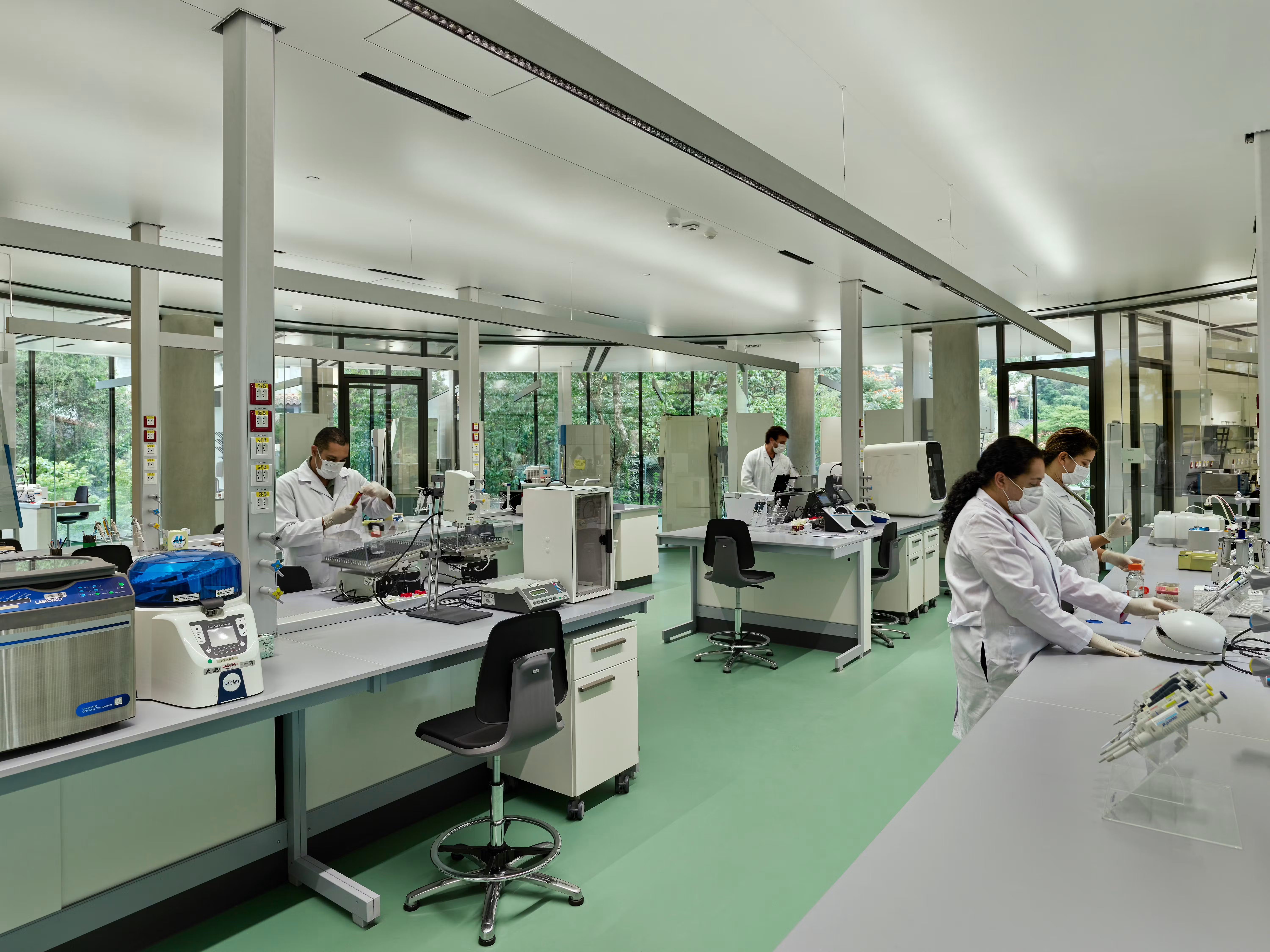
Laboratory modernization in academic medical centers is a goal that appears regularly in strategic plans and with equal regularity fails to materialize on the timeline those plans describe.
The gap between aspiration and execution is not a failure of intent. It is a function of the specific constraints that govern capital investment in hospital research environments — constraints that the conventional modernization narrative does not account for.
The Conventional Modernization Path and Why It Stalls
The standard approach to laboratory modernization assumes a capital replacement model: aging or non-networked instruments are replaced with modern, connected alternatives that can interface directly with LIMS, study data management systems, and institutional informatics infrastructure.
In pharmaceutical or commercial biotech settings, that model is viable. Instruments are managed as operational assets with defined replacement cycles. Capital budgets for laboratory equipment are planned at the enterprise level. The informatics investment required to connect new instruments to enterprise systems is anticipated as part of the upgrade.
In academic medical centers, none of those assumptions hold reliably.
Research lab instrument environments are assembled across time, across funding sources, and across research programs. A lab running five instruments may have acquired them from three different grants, one departmental budget, and a manufacturer donation. The instruments serve active research programs that depend on their continued, undisrupted operation. Replacing one instrument triggers a revalidation or requalification process that requires time and resources the department may not have. And the capital budget for new instrumentation competes with clinical equipment priorities that institutional leadership has more visibility into.
The result is that the "replace and connect" modernization path is available to very few research departments — and the ones that pursue it typically do so one instrument at a time, over a multi-year timeline, with disruption to research programs that makes the investment politically and operationally difficult.
The Alternative: Connect What Exists
The modernization approach that is gaining traction in academic medical center research environments starts from a different premise: the instruments are not the problem. The data infrastructure around them is.
A research lab instrument that is generating accurate measurements and operating within its validated parameters is providing exactly the value it was acquired to provide. The gap is not in the measurement. It is in how the measurement reaches the system that needs to use it.
Instrument connectivity infrastructure addresses that gap without touching the instrument. A purpose-built connectivity layer — hardware where necessary, software throughout — sits between the existing instrument and the enterprise data system. It handles the protocol translation required to communicate with legacy instrument interfaces, the data normalization required to convert proprietary instrument output into a format the receiving system can use, and the audit trail capture required to meet GCP documentation standards.
The instrument continues operating exactly as before. Its validated configuration does not change. Its research program does not require interruption for requalification. What changes is the path its data takes — from a manual workflow that depends on operator transcription to an automated, documented, compliant data flow that reaches the study management system at the moment of measurement.
What This Means for Capital Planning
For academic medical center research leadership, the instrument connectivity approach changes the capital planning conversation in several meaningful ways.
The investment category is different. Instrument connectivity infrastructure is a data systems investment, not an instrument capital expenditure. In most institutions, those categories carry different approval pathways, different budget cycles, and different stakeholder review processes. Research departments that have been unable to secure capital for instrument replacement may find the data infrastructure investment more accessible in the institutional context.
The risk profile is different. Replacing an instrument in an active research program requires managing the validation and qualification impact, the research continuity implications, and the operational transition from old workflow to new. Adding a connectivity layer to an existing instrument carries none of those risks. The instrument continues operating. The research program continues without interruption.
The timeline is different. Instrument replacement programs in academic medical centers routinely stretch over years, particularly when instruments are replaced one at a time as capital becomes available. Connectivity infrastructure can be deployed across a multi-instrument environment in a fraction of that timeline, producing data management improvements that accrue immediately rather than at the end of a multi-year replacement cycle.
The Practical Starting Point
Most research departments that are beginning to address instrument data infrastructure start with the highest-friction point in their current workflow — the instrument or instrument category where manual data handling creates the most documentation burden, the most compliance risk, or the most QA friction.
For clinical pharmacology labs, that is often bioanalytical instruments where study data verification is frequent and thorough. For translational research departments, it may be the hematology or chemistry analyzers that generate primary endpoint data across multiple active studies. For research hospitals with GCP compliance exposure, it is wherever the gap between instrument output and auditable study record is widest.
Starting there, rather than attempting a facility-wide modernization, produces visible results quickly — and builds the internal case for extending the connectivity approach to additional instruments over time.
About Phizzle
At Phizzle, we built Connected Plant and the Edge Puck™ to be the connectivity layer that academic medical centers and research hospitals can deploy within existing capital and IT constraints. Our platform connects the instrument fleet you have — not the one you would buy if budget were unlimited — and delivers compliant, auditable instrument data to your study management systems without disrupting active research programs.
The Instruments Are There
Large academic medical centers are modernizing research lab data infrastructure. The path they are using does not look like the conventional modernization narrative — it does not involve replacing instruments or replatforming data systems. It involves connecting what already exists to the data infrastructure that needs its output.
That approach is available now, within current capital constraints, without disrupting active research programs. The instruments are there. The data management gap is there. The connectivity layer is what closes it. If this is a challenge your institution is working through, let's talk.